
A wireless CarPlay adapter converts an existing compatible wired CarPlay connection into a wireless connection. A CarPlay AI Box typically goes further by introducing an independent Android-based environment that can support additional applications and connectivity features.
For automotive electronics distributors, however, the better product is not necessarily the one with more functions. It is the one that matches local vehicles, customer expectations, and purchasing preferences.
Through our customer interactions at WoobooMagic, we have learned that successful product selection begins with understanding the target market rather than simply comparing technical specifications.
Even a technically impressive product can become slow-moving inventory if the intended customers cannot use it.
Wireless CarPlay Adapter vs. AI Box: The Main Differences
Although both product categories aim to improve the in-car infotainment experience, they address different customer needs.
A conventional wireless CarPlay adapter improves the convenience of an existing compatible smartphone connection. It allows users to access supported navigation, music, communication, and voice-control functions through their vehicle's display without connecting their smartphones by cable each time.
A CarPlay AI Box generally incorporates its own computing hardware and Android operating environment. Depending on the selected configuration, it may support additional applications, internet browsing, media playback, and customizable software interfaces.
| Comparison | Wireless CarPlay Adapter | CarPlay AI Box |
|---|---|---|
| Primary purpose | Wireless smartphone projection | Expanded infotainment functionality |
| Operating environment | Primarily smartphone-based | Often includes an independent Android system |
| Typical functions | Navigation, music, and communication | Smartphone projection and model-dependent native applications |
| Hardware complexity | Generally lower | More dependent on processor, memory, and software configuration |
| Internet connectivity | Usually relies on the smartphone | Selected models support independent connectivity |
| Customization priorities | Product branding and packaging | Physical branding and potential software customization |
| Typical market position | Essential connectivity and convenience | Advanced software and infotainment experience |
Neither category is universally superior. Each addresses a different combination of customer requirements, compatibility conditions, and price expectations.
Compatibility Comes Before Specifications
One of the compatibility issues we encounter during customer consultations is that some vehicles do not have the CarPlay functionality required by the intended product.
The presence of a touchscreen, Bluetooth connection, or USB port does not automatically establish compatibility.
Conventional wireless CarPlay adapters generally require an existing compatible wired CarPlay connection. Many AI Boxes also depend on a specific host-system protocol, although specialized products may have different requirements.
When customers tell us that their vehicles lack the necessary CarPlay functionality, we do not recommend purchasing an incompatible adapter or AI Box simply to see whether it works.
Instead, we suggest consulting the vehicle manufacturer's dealership or a qualified automotive electronics specialist about a suitable infotainment upgrade.
Even after replacing the head unit, compatibility with the intended adapter or AI Box should be confirmed separately.
This distinction is particularly important for wholesalers. A compatibility misunderstanding involving one retail customer may result in a return. The same misunderstanding repeated across a wholesale order can create a much larger inventory and after-sales problem.
Before comparing processors, memory, or additional features, distributors should establish whether their target customers can actually use the product.
For a more detailed explanation of vehicle compatibility, USB connections, firmware, and host-system requirements, refer to our CarPlay AI Box compatibility guide.
What Are Customers Actually Buying?
Understanding why customers purchase CarPlay products can help distributors build a product range around genuine demand rather than specification sheets alone.
Everyday Convenience
Many customers primarily want convenient access to navigation, online music, calls, and supported voice-control functions through their existing vehicle display.
They may want to reduce their reliance on dashboard-mounted smartphones or avoid repeatedly connecting a USB cable whenever they enter the vehicle.
For customers who would otherwise position their smartphones in direct sunlight for navigation, using a compatible vehicle display may also allow the phone to be placed elsewhere.
However, the operating temperature limits of the smartphone, adapter, and vehicle infotainment system must be considered independently.
Voice-controlled functions can reduce certain manual interactions with the display, but they do not eliminate driver distraction. Drivers must remain attentive and comply with applicable road safety requirements.
For customers seeking these essential functions, a compatible wireless adapter may be a practical and cost-conscious choice.
Expanded Infotainment
Other customers are interested in a broader software experience.
In our customer discussions, AI Box buyers have expressed interest in additional applications, internet browsing, and passenger entertainment, particularly during longer journeys.
For these customers, the ability to run compatible native applications may be more important than wireless smartphone connectivity alone.
However, not every AI Box provides the same application support or performance. The actual experience depends on the hardware configuration, operating system, firmware, network connection, and requirements of the intended applications.
A newer Android version or larger memory capacity should not be treated as an automatic guarantee of better performance.
Entertainment videos, gaming, and other distracting activities should only be used while safely parked or on permitted passenger displays under applicable laws. Drivers must not watch entertainment videos or play games while driving.
What We Have Observed Across Different Markets
Our customer interactions have revealed differences in purchasing interests across Europe, the United States, and the Middle East.
These observations can help distributors identify potential opportunities, provided they are treated as business experience rather than comprehensive market statistics.
Europe and the United States
Among the customers we have dealt with in Europe and the United States, CarPlay AI Boxes have attracted considerable interest.
For distributors targeting these markets, it may be worthwhile to evaluate products offering additional applications, expanded connectivity, and different software configurations.
However, this does not mean wireless adapters lack demand in these regions.
Both product categories should be evaluated according to local vehicle configurations, customer requirements, retail positioning, and actual purchasing behavior.
Middle Eastern Markets
Among the Middle Eastern customers we have dealt with, wireless CarPlay adapters have attracted considerable interest.
Products focused on convenient wireless connectivity, navigation, music, and straightforward operation may therefore provide a useful starting point for distributors evaluating these markets.
Nevertheless, the Middle East should not be treated as a single uniform market. Different countries have different vehicle populations, consumer preferences, purchasing conditions, and applicable product requirements.
Our regional observations are based on actual customer interactions. They do not represent comprehensive sales statistics, market shares, or guaranteed future demand.
Distributors should use them as starting points for local market research rather than fixed rules for purchasing inventory.
The Inventory Mistake New CarPlay Distributors Should Avoid
From our perspective, one of the most important mistakes a new CarPlay distributor can make is purchasing products before sufficiently investigating the infotainment systems commonly used in the target market.
A product may offer attractive pricing, advanced hardware, and appealing packaging. However, these advantages have limited commercial value if a substantial portion of the intended customers cannot use it.
Incorrect product selection can lead to slow-moving inventory, unnecessary compatibility inquiries, avoidable returns, and increased after-sales support requirements.
Before deciding what to stock, distributors should investigate three separate questions.
1. Which Customers Can Actually Use the Product?
Identify the vehicle brands, model years, regional configurations, and infotainment systems commonly encountered among your target customers.
Determine whether those vehicles support the connection protocols required by the intended products.
Vehicle age alone is not a reliable compatibility indicator.
An older vehicle equipped with a compatible infotainment system may support a wireless adapter, while a newer vehicle with a different connection architecture may require another solution.
2. Which Functions Do Customers Actually Want?
After identifying compatible vehicles, investigate the functions customers are looking for.
Some consumers primarily want convenient wireless navigation and music. Others may be interested in additional software, independent connectivity, or passenger entertainment.
A distributor should not assume that every customer with an advanced vehicle wants an AI Box, or that every owner of an older vehicle prefers an inexpensive adapter.
Product selection should reflect actual customer requirements.
3. What Price Position Can the Market Support?
Evaluate the intended retail price, customer willingness to pay, and the level of technical support each product may require.
A relatively affordable wireless adapter may appeal to customers seeking essential connectivity, while a more advanced AI Box may suit customers who value additional software capabilities.
These decisions should be based on observed purchasing behavior rather than assumptions about customer income or vehicle age.
The objective is not simply to stock the most advanced products. It is to stock products that the intended customers can use and are willing to purchase.
Building a Practical CarPlay Product Portfolio
For businesses entering the CarPlay market, we recommend evaluating a focused product range before committing to a large number of models.
A potential product portfolio can be organized around three customer needs.
| Portfolio position | Product category | Intended customer |
|---|---|---|
| Essential connectivity | Conventional wireless adapter | Customers seeking convenient smartphone projection |
| Expanded infotainment | Android-based AI Box | Customers interested in additional applications and software functions |
| Specialized requirements | Model-specific connectivity products | Customers requiring particular host protocols or communication features |
This is a suggested product portfolio framework, not a prescribed inventory allocation.
The appropriate quantity of each category should depend on local compatibility research, customer inquiries, acceptable retail prices, and sample evaluation.
A focused product range that distributors understand well may be easier to sell and support than a broad catalog selected without sufficient market research.
OEM/ODM Customization: Different Products, Different Priorities
Another distinction we observe in B2B customer discussions is the type of customization buyers request.
Wireless adapter buyers often focus on physical branding, while AI Box buyers may be more interested in creating a distinctive software experience.
Wireless Adapter Customization
Customers interested in wholesale and private-label wireless adapters commonly discuss:
- Customized retail packaging.
- Laser-marked brand logos.
- Product surface branding.
For these customers, establishing a recognizable retail identity may be more important than extensively modifying the software environment.
The available branding methods depend on the selected product's housing material, design, and project requirements.
CarPlay AI Box Customization
AI Box customization discussions can extend considerably further.
Requests we have encountered include:
- Customized boot logos.
- Brand-specific visual styles.
- Additional or specialized languages.
- Redesigned system interfaces.
- Complete UI redesign concepts.
- Preinstalled applications.
For some buyers, the software experience itself is an important part of product differentiation.
Rather than relying solely on enclosure branding or packaging, they may wish to develop a user interface that reflects their own automotive electronics brand.
However, these are customization requests we have encountered, not capabilities guaranteed to be available on every model.
Extensive UI changes, language customization, and application installation must be evaluated against the selected hardware platform, firmware permissions, technical feasibility, and applicable software distribution rights.
The final customization scope, development requirements, order conditions, and delivery arrangements should be agreed for each project.
For more detailed customization planning, refer to our CarPlay AI Box OEM/ODM guide.
How to Evaluate CarPlay Products Before Bulk Purchasing
There is no universal ranking of processors, memory, operating systems, and other specifications that applies to every distributor.
Instead, we suggest using the following six-stage purchasing framework.
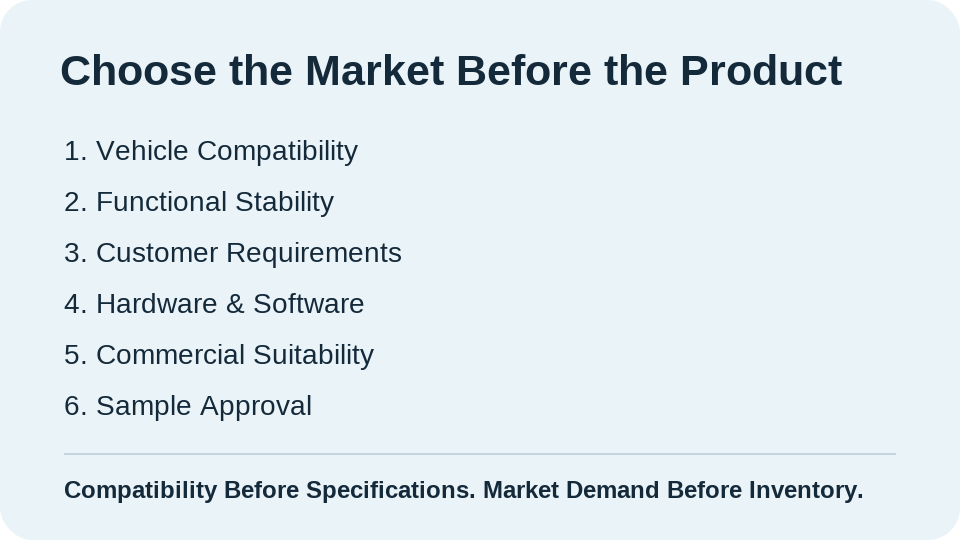
1. Vehicle Compatibility
Confirm whether the intended customers can use the product with their existing or appropriately upgraded infotainment systems.
2. Functional Stability
Evaluate whether representative samples perform their intended functions consistently under relevant usage conditions.
3. Customer Requirements
Determine whether the available functions address actual local customer demand.
4. Hardware and Software Configuration
Assess the processor, memory, storage, operating system, and firmware in relation to the intended applications and workload.
5. Commercial Suitability
Confirm whether pricing, customization scope, product documentation, applicable compliance requirements, and after-sales arrangements support the intended distribution strategy.
6. Sample Approval
Evaluate the exact proposed product configuration before committing to bulk inventory.
A more powerful processor cannot compensate for an incompatible host system. Similarly, additional memory may offer limited commercial value if customers do not require the applications it is intended to support.
For AI Boxes equipped with SIM connectivity, buyers should also distinguish mobile internet access from conventional mobile telephone functionality.
A SIM card slot alone does not establish independent voice-calling capability. The exact communication functions must be confirmed for the selected hardware revision and supported network services.
This evaluation framework is intended to help buyers connect technical product selection with practical commercial requirements.
Frequently Asked Questions
Can a wireless CarPlay adapter work in a car without CarPlay?
A conventional wireless CarPlay adapter generally cannot add CarPlay to a vehicle that lacks the required host functionality. A compatible replacement head unit or dedicated retrofit solution may be necessary.
Do wireless CarPlay adapters work with older cars?
Vehicle age alone does not determine compatibility. An older vehicle with a suitable connection protocol may support an adapter, while another vehicle may not. Check the infotainment system and the exact product's host requirements.
Can a wireless CarPlay adapter also support Android Auto?
Some dual-platform adapters support both wireless Apple CarPlay and Android Auto.
Apple CarPlay is designed for compatible iPhones. Android phone users should evaluate Android Auto support separately.
Compatibility depends on the selected adapter, smartphone, vehicle, and required connection method.
Can a wireless CarPlay adapter play Netflix or YouTube?
A conventional wireless-only adapter does not by itself add general Android applications or unrestricted video playback.
Selected AI Boxes or specialized video products may support additional media applications, subject to hardware, software, regional availability, and application requirements.
Video entertainment should only be used while safely parked or on permitted passenger displays.
Should a new distributor start with wireless adapters or AI Boxes?
Begin with local vehicle compatibility and customer demand.
Wireless adapters may suit customers seeking essential connectivity, while AI Boxes may suit customers interested in additional software functionality.
Evaluate representative samples before committing to bulk quantities.
Can a CarPlay AI Box be customized with an entirely different interface?
Complete UI redesign is among the customization requests we have encountered.
Actual availability depends on the selected hardware platform, technical feasibility, software permissions, and agreed project scope.
Conclusion
For automotive electronics distributors, choosing between wireless CarPlay adapters and AI Boxes should begin with understanding the market rather than comparing specification sheets alone.
Local vehicle compatibility, customer expectations, retail positioning, and customization requirements all influence whether a product is commercially suitable.
Our recommendation at WoobooMagic is straightforward:
Compatibility before specifications. Market demand before inventory.
Before selecting a product range, identify the vehicles and consumers you intend to serve. Evaluate compatible configurations, confirm actual functions through representative samples, and establish the appropriate commercial arrangements.
Explore our wireless CarPlay adapters, CarPlay AI Boxes, and OEM/ODM options, or share your target market and purchasing requirements with us.
Final specifications, compatibility, customization availability, and commercial terms should be confirmed for the selected configuration.
About the Author
Cherry — Website Content Specialist, WoobooMagic
Cherry has four years of industry experience and focuses on CarPlay technology and related automotive infotainment products.
Her work involves developing and fact-checking website content, helping readers better understand product functionality, vehicle compatibility, and practical purchasing considerations.
Editorial Sources
- Apple — CarPlay: https://www.apple.com/ios/carplay/
- Google — Get started with Android Auto: https://support.google.com/androidauto/answer/6348019
- WoobooMagic customer interactions and original industry interviews.
Apple and Google resources support general smartphone projection knowledge. Regional purchasing observations and customization examples are based on WoobooMagic customer interactions and do not represent comprehensive market statistics or universal product capabilities.
The purchasing framework is editorial guidance rather than an independently certified industry standard.