
How to Choose a Reliable Wireless CarPlay Adapter Manufacturer: A 15-Point B2B Checklist
Short answer: Choose a wireless CarPlay adapter manufacturer by verifying the legal supplier identity, product ownership, firmware support, compatibility data, change-control process, market-specific compliance, factory testing, sample-to-production consistency, shipment inspection and RMA response. Compare written evidence and approved samples, not only price, catalog size or marketplace ratings.
The wireless CarPlay category is easy to enter and difficult to manage well. Many suppliers can provide a working sample. Fewer can keep the same hardware and firmware stable across repeated production, explain compatibility exceptions, support a private-label listing and respond when a phone or vehicle update changes behavior.
For an importer, distributor or ecommerce brand, the supplier decision affects much more than the purchase price. It influences return rate, customer reviews, technical-support cost, listing continuity, compliance risk and the speed of future firmware fixes.
This guide provides a 15-point checklist for comparing manufacturers and trading suppliers. It does not assume that the largest factory is automatically the best. The goal is to identify the partner whose product, documentation and operating process fit your market.
Manufacturer, solution provider or trading company: what are you buying?
The word “manufacturer” is used loosely in consumer electronics. A company may own the industrial design and firmware while outsourcing assembly. Another may assemble hardware developed by a solution provider. A trading company may offer useful sourcing and export service without owning engineering.
None of these structures is automatically unacceptable. The risk appears when the supplier cannot explain who controls the critical parts of the product.
Ask four questions early:
- Who owns or controls the firmware branch used for this model?
- Who approves hardware substitutions and bill-of-material changes?
- Who investigates vehicle compatibility issues?
- Who is responsible for the warranty and corrective action after shipment?
A supplier that gives clear, consistent answers is easier to manage than one that presents every function as “no problem” but cannot identify the engineering owner.
The 15-point manufacturer evaluation checklist
1. Verify the legal company and export identity
Confirm the legal company name, registered address, business scope, invoicing entity, export entity and bank beneficiary. The quotation, contract, payment instructions and shipment documents should form a coherent chain.
If the seller and manufacturer are different companies, document the relationship. This matters when handling compliance files, warranty responsibility or a payment dispute.
Evidence to request: business license, company bank details, factory address, export entity and named commercial contact.
2. Identify the real product and engineering owner
Ask whether the model is proprietary, jointly developed, a public solution or a standard product with cosmetic customization. Request the product model, PCB or hardware revision, chipset and current firmware identifier.
The answer determines how much customization and long-term support are realistic. A seller may be able to print a logo but not modify reconnection logic, user interface or vehicle-specific behavior.
Red flag: the model number, chipset or firmware changes between the quotation, sample and technical sheet.
3. Match the product architecture to the use case
Do not compare every adapter as if it were the same product. Define the category first:
| Buyer need | Typical product category | Important checks |
|---|---|---|
| Convert wired CarPlay to wireless | Basic wireless CarPlay adapter | Reconnection, audio delay, call quality, USB compatibility |
| Support iPhone and Android drivers | 2-in-1 adapter | Both CarPlay and Android Auto test matrix |
| Add mirroring functions | 4-in-1 adapter | App/OS limitations, video handling, setup clarity |
| Add a standalone Android environment | CarPlay AI Box | Chipset, RAM/storage, OS, heat, app behavior, GPS/4G |
| Add defined media or HDMI functions | Video box or HDMI model | Resolution, content source, HDMI direction, control behavior |
Wooboomagic's catalog, for example, separates compact wireless adapters, T-series 4-in-1 adapters, Y-series video boxes and GT-series Android AI boxes. That category discipline helps buyers avoid comparing a simple converter with a full computing device on price alone.
4. Review compatibility evidence, not compatibility slogans
“Works with 98% of cars” is not enough for a sourcing decision. Ask how the figure was produced and which product/firmware version it covers.
A useful compatibility record identifies the vehicle, year, region, head unit, host requirement, control method, test date and firmware. It also records exceptions. Buyers should prioritize evidence for the vehicles that generate most sales in their target markets.
Ask the supplier to demonstrate its process for a new vehicle issue: intake, reproduction, engineering analysis, firmware release, regression test and customer communication.
5. Evaluate firmware maintenance and OTA control
Wireless adapters depend on software behavior across the phone, product and vehicle. Firmware support should include:
- a controlled release process;
- release notes describing fixes and affected models;
- safe update instructions;
- recovery or rollback procedure when appropriate;
- update-server availability and access control;
- regression testing before release;
- a defined period of support for shipped models.
Ask whether the buyer can approve a firmware version for mass production. If units update automatically, clarify whether updates can be staged or paused for a private-label program.
6. Check hardware and bill-of-material stability
Two products can look identical while using different wireless modules, memory, flash, power components or PCB revisions. A component substitution may be commercially necessary, but it should follow change control.
Require written notice before changes to:
- processor or wireless chipset;
- memory or storage vendor/capacity;
- PCB layout or power circuit;
- USB cable specification;
- enclosure material or heat-dissipation design;
- firmware branch;
- label or packaging content.
The buyer should decide which changes require a new sample, limited regression test or full reapproval.
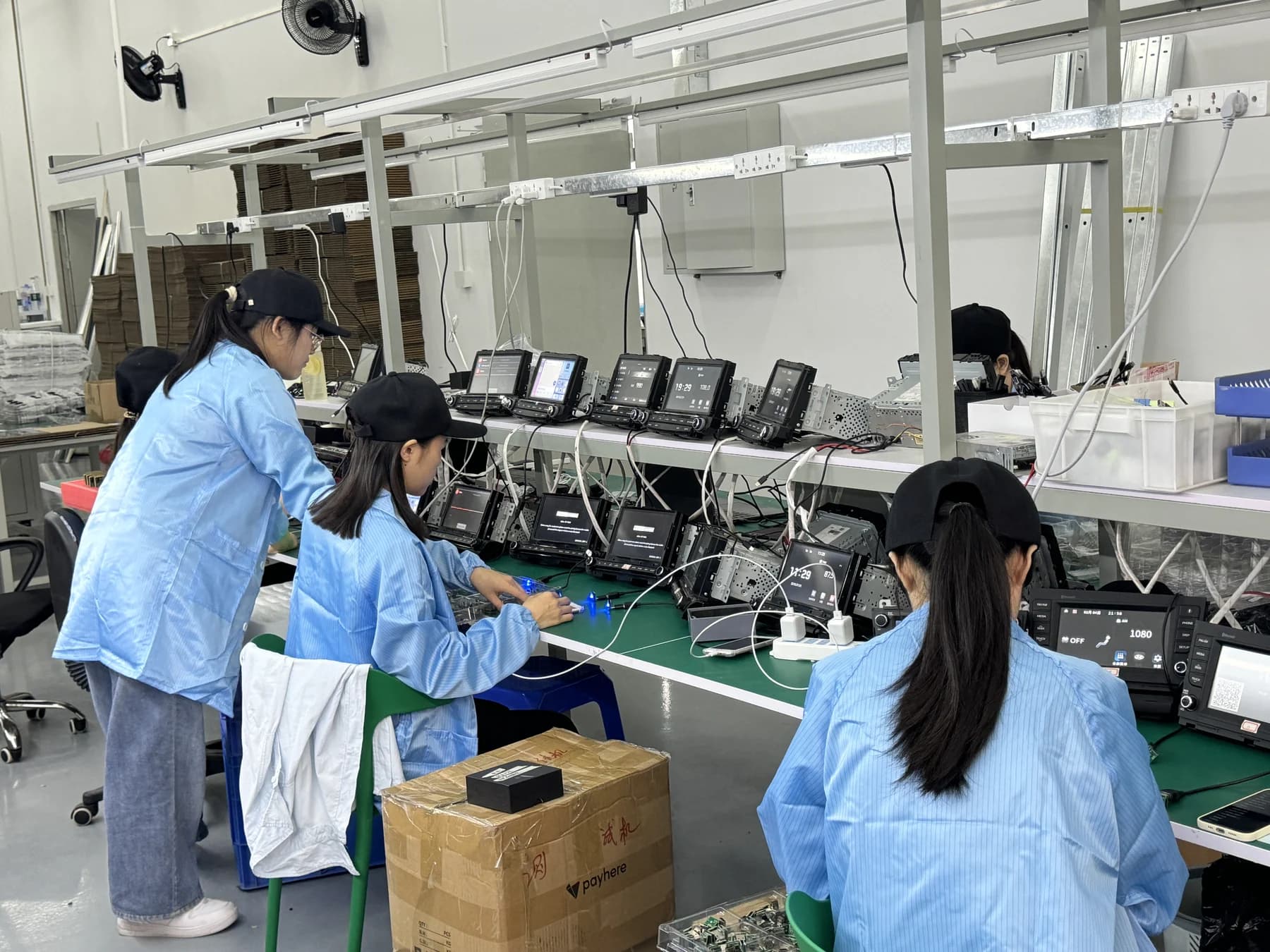
7. Inspect the factory test process
A production line should test the functions that matter in real use, not only electrical power-on. Ask to see the test instruction and pass criteria.
A reasonable functional check may include USB enumeration, boot, CarPlay/Android Auto connection, Bluetooth/Wi-Fi operation, audio, buttons, LED behavior, firmware version and update function. AI boxes may require additional checks for storage, GPS, cellular module, HDMI, TF card or USB peripherals.
Factory testing should be traceable to the product version. If a test station displays only a green light without recording what was tested, ask how failures and rework are controlled.
8. Compare the sample with mass-production controls
The best sample has limited value if it cannot be reproduced. Create a golden-sample file containing:
- exterior photographs;
- dimensions, weight and materials;
- model and serial-label format;
- PCB/hardware revision if available;
- firmware version and checksum or build identifier;
- cable and accessory specification;
- packaging, manual and carton marks;
- approved functional-test results.
Add a contract clause or purchase-order note that requires production to match the approved configuration and change-control procedure.
9. Verify market-specific compliance documents
Wireless products contain intentional radio transmitters and digital electronics. Compliance requirements depend on the destination, product configuration, labeling and responsible economic operator.
For the European Union, buyers commonly need to assess the Radio Equipment Directive and RoHS obligations. The EU Radio Equipment Directive places responsibility on the manufacturer for conformity and requires supporting technical documentation and an EU Declaration of Conformity. RoHS restricts specified hazardous substances in electrical and electronic equipment.
For the United States, the FCC equipment-authorization framework applies to radio-frequency devices before marketing or importation. The buyer should verify that the report, grantee or responsible-party details, labeling and exact hardware configuration are relevant to the product being purchased.
Do not accept a logo on a product photo as proof. Review the report scope, model names, standards, issue date, laboratory and relationship to the production hardware. Engage a qualified compliance professional for the destination market.
Mid-article CTA - Ask for the Supplier Capability Pack
Comparing wireless CarPlay suppliers? Request Wooboomagic's current product catalog, customization scope and sample-evaluation checklist. Use the same evidence categories across every supplier. CTA button: Ask for Product Catalog
10. Audit packaging and labeling readiness
Packaging is part of the delivered product. Check whether the supplier can control:
- brand artwork and color references;
- product/model label;
- barcode or marketplace label;
- regulatory marks and responsible-party details;
- country-of-origin statement;
- multilingual manual and safety information;
- accessories and cable labels;
- master-carton marks and quantities.
Run a barcode scan and compare artwork against an approved PDF before printing. For a pilot run, inspect the physical print rather than approving only a screen proof.
11. Review shipment-inspection discipline
Agree on the inspection standard before the purchase order. A shipment inspection can include:
- quantity and carton condition;
- model, color and label match;
- workmanship and connector fit;
- firmware-version verification;
- accessory completeness;
- packaging and barcode checks;
- functional sampling against the golden sample;
- defined critical, major and minor defect categories.
The sample size and acceptance criteria should reflect lot size, product maturity and risk. New private-label programs often justify stronger checks than repeat orders with stable data. Some buyers choose 100% functional checks for small pilot batches and risk-based sampling for later production.
12. Test technical support before placing the order
Send a realistic technical question during supplier evaluation. Good responses separate prerequisite checks, known limitations and next diagnostic steps. Weak responses repeat “reset and try again” without collecting evidence.
Ask who receives escalation logs, what information is required, typical working hours and how firmware cases are tracked. The quality of pre-sale technical communication often predicts post-sale support.
13. Define warranty, RMA and corrective action
Clarify the warranty start point, duration, exclusions, defective-unit evidence and credit/replacement process. For recurring failures, require a root-cause and corrective-action response rather than repeated unit replacement.
An RMA process should preserve model, batch, serial and firmware data. Without traceability, neither buyer nor supplier can distinguish an isolated user issue from a batch-level problem.
14. Verify capacity, lead time and supply continuity
Ask for realistic sample, pilot and mass-production lead times. Separate material preparation, assembly, aging/testing, packaging and export booking. If the supplier promises a very short lead time, ask whether finished neutral stock is being relabeled or whether the full configuration is actually available.
For important chipsets or memory configurations, discuss allocation, alternative parts and end-of-life notice. A supply-continuity plan matters when the same listing must remain stable for multiple seasons.
15. Compare total landed risk, not only unit price
The lowest quotation can become expensive after freight, duties, return handling, replacements, support labor, listing damage and emergency firmware work.
Build a comparison table with:
- unit price at the same Incoterm;
- tooling and customization fees;
- packaging and certification costs;
- sample and inspection costs;
- warranty allowance;
- expected support workload;
- minimum order and cash exposure;
- lead-time and change risk.
Pricing should be evaluated only after the compared configurations are technically equivalent.
A supplier scorecard buyers can actually use
Avoid a decorative 100-point score that hides critical failures. Use gates and weighted criteria.
Gate criteria
A supplier should not move forward if it fails a non-negotiable condition such as:
- inconsistent legal/payment identity;
- inability to identify the production model or firmware;
- missing market-critical compliance evidence;
- refusal to control material or firmware changes;
- no workable warranty responsibility.
Weighted criteria
For suppliers that pass the gates, a practical weighting might be:
| Area | Suggested weight | Evaluation basis |
|---|---|---|
| Product fit and compatibility | 25% | Target-vehicle results and documented limitations |
| Firmware and engineering support | 20% | Release process, response quality and change control |
| Quality and production control | 20% | Test plan, traceability and golden-sample discipline |
| Compliance and documentation | 15% | Relevant, current and configuration-specific evidence |
| Commercial and supply terms | 10% | Price, MOQ, lead time and continuity |
| Communication and after-sales | 10% | Ownership, response structure and RMA process |
Change the weights for the business model. A marketplace brand with high review sensitivity may weight compatibility and support more heavily. A promotional-products buyer may prioritize packaging speed but should not waive safety or radio compliance.
Questions to ask during a factory video call or visit
- Show the current production unit and its model/firmware screen.
- Show how a failed functional test is recorded and segregated.
- Show the approved sample or work instruction at the station.
- Explain who can authorize a component substitution.
- Demonstrate the firmware-update and recovery process.
- Show how serial or batch information links to production.
- Explain how a new vehicle compatibility case reaches engineering.
- Show packaging inspection and barcode verification.
- Identify where completed goods wait for shipment inspection.
- Provide a recent example of a controlled corrective action with confidential details removed.
The purpose is not to demand a perfect factory tour. It is to see whether the stated process exists and whether different team members describe it consistently.
Common sourcing red flags
- Every product is described as self-developed, but no engineering owner can be named.
- The supplier avoids sending firmware and hardware identifiers.
- Compliance reports use unrelated model numbers with no declaration linking the series.
- The sample works, but the supplier will not freeze its configuration.
- “Universal compatibility” is promised without a vehicle matrix or exception policy.
- OTA updates are available, but there are no release notes or recovery instructions.
- Packaging artwork begins before technical and compliance content is approved.
- The quotation omits cable, packaging, license, tooling or inspection costs.
- Warranty terms are discussed only after a defect occurs.
- The sales contact answers every technical question immediately without checking evidence.
FAQ
Is a factory always better than a trading company?
No. A capable trading or solution company may provide strong product management and export support. Verify who controls engineering, production changes, compliance and warranty. Transparency matters more than the label.
What certifications should a wireless CarPlay adapter supplier provide?
The answer depends on the destination and exact radio configuration. EU buyers commonly assess RED and RoHS obligations; US buyers commonly verify the relevant FCC authorization. Ask a qualified compliance professional to review configuration-specific documents.
How many samples should a B2B buyer test?
There is no universal number. Test enough units and vehicle/phone combinations to cover the target-market risks. Use a small controlled pilot before a large private-label shipment, and keep an approved golden sample.
Should buyers require an OTA firmware function?
OTA can reduce service cost, but only when release control, security, recovery and regression testing are clear. An uncontrolled update channel can create new risk.
How can I confirm that mass production matches the sample?
Freeze the hardware, firmware, cable, labels and packaging in a golden-sample record. Require change notification and verify the configuration during production and shipment inspection.
What is a reasonable MOQ?
MOQ depends on whether the product is neutral stock, logo customized, packaging customized, firmware customized or newly tooled. Compare MOQs only after defining the customization scope and component commitments.
What should be included in an RFQ?
Include target countries, sales channel, desired product category, vehicle prerequisites, phone platforms, required functions, customization, compliance needs, estimated quantities, target launch date and inspection expectations.
Conclusion
A reliable wireless CarPlay adapter supplier is not simply the company with the widest catalog or the fastest quotation. The better partner can identify the product it is selling, reproduce the approved sample, maintain firmware, explain compatibility boundaries, support compliance and respond to evidence after shipment.
Use the 15 points as a common data request across shortlisted suppliers. Pass/fail gates protect the project from basic risk. Weighted criteria then help the buying team compare qualified options without letting a small price difference dominate the decision.
Final CTA - Compare Your Requirements with a Real Product Plan
Share your target market, product category, expected quantity and customization needs. Wooboomagic can prepare a relevant model shortlist, sample path and quotation basis for your review. CTA button: Get a B2B Quote
SEO information
- SEO title: How to Choose a Wireless CarPlay Adapter Manufacturer
- Meta description: Use this 15-point B2B checklist to compare wireless CarPlay adapter manufacturers, verify QC, firmware, compliance and shipment support.
- URL slug:
/blog/choose-wireless-carplay-adapter-manufacturer/ - H1: How to Choose a Reliable Wireless CarPlay Adapter Manufacturer: A 15-Point B2B Checklist
- Recommended internal links: OEM/ODM page, specifications hub, compatibility guide, private-label guide, inquiry page
- Recommended page schema:
ArticleandBreadcrumbList
Image plan and AI generation prompts
Image 1 - Supplier evaluation hero
- Purpose: Establish a professional sourcing and manufacturing context.
- Insert position: Below the introduction.
- Caption: A reliable supplier decision combines product evidence, engineering ownership and production control.
- ALT text: B2B buyer reviewing wireless CarPlay adapter samples with a factory engineer
- AI prompt:
Premium B2B editorial photograph, international buyer and electronics factory engineer reviewing several compact wireless CarPlay adapter samples on a clean meeting table, specification sheets and laptop with generic charts, bright modern Shenzhen manufacturing office, white silver and soft blue color palette, trustworthy documentary style, 16:9, no readable logos, no watermark
Image 2 - Production functional test
- Purpose: Support the factory testing and quality-control criteria.
- Insert position: After checklist point 7.
- Caption: Functional testing should verify the communication functions defined in the product specification, not only power-on.
- ALT text: Wireless CarPlay adapter production line functional testing station
- AI prompt:
Photorealistic consumer electronics factory testing station, technician connecting compact wireless CarPlay adapters to automotive infotainment simulators, Bluetooth and Wi-Fi test equipment, organized anti-static workbench, clear but non-readable status screens, clean professional lighting, authentic quality-control environment, 3:2, no logos, no watermark
Image 3 - Compliance and golden-sample review
- Purpose: Visualize document-to-product verification.
- Insert position: After checklist point 9.
- Caption: Compliance files must match the model, radio configuration and production hardware being purchased.
- ALT text: Inspector comparing a wireless adapter golden sample with compliance documents and labels
- AI prompt:
High-end close-up documentation audit, gloved inspector comparing a compact wireless automotive adapter, model label, blank compliance report pages and approved golden sample photos, precise desk layout, soft neutral lighting, realistic professional quality-assurance photography, 16:9, no legible certification numbers, no brand logos, no watermark
Image 4 - Shipment inspection
- Purpose: Demonstrate packaging, barcode and batch checks before export.
- Insert position: Before the supplier scorecard.
- Caption: Pre-shipment inspection connects the approved sample to the actual export lot.
- ALT text: Inspector checking private-label wireless CarPlay adapters before shipment
- AI prompt:
Professional export shipment inspection in a clean warehouse, private-label wireless CarPlay adapter boxes with blank elegant branding, inspector scanning a barcode and opening random cartons, products and USB cables visible, orderly pallets in background, premium realistic photography, soft daylight, 16:9, no readable logos, no watermark
CTA and inquiry popup plan
Mid-article CTA
- Position: After point 9, around 45% scroll depth.
- Format: Inline comparison-assistance panel.
- Headline: Need comparable supplier evidence?
- Body: Request the current catalog and a structured capability checklist covering compatibility, firmware, customization and quality control.
- Button: Ask for Product Catalog
- Destination:
/inquiry/?source=blog-manufacturer-mid
Final CTA
- Position: After the conclusion.
- Format: Full-width quote panel.
- Headline: Build your shortlist around the right product requirements.
- Body: Send your market, channel, quantity and must-have functions for a relevant model and sample recommendation.
- Button: Get a B2B Quote
- Destination:
/inquiry/?source=blog-manufacturer-end
Optional popup
- Trigger: 40% scroll depth or 30 seconds on page. Desktop exit intent may be used as a fallback. Frequency cap: once per seven days.
- Popup title: Comparing CarPlay Adapter Suppliers?
- Description: Get a current product catalog and a checklist for comparing firmware, compatibility, OEM options and shipment controls.
- Fields: Name (required), Business Email (required), Phone/WhatsApp (required), Company, Country/Region, Product Interest
- Submit button: Send Me the Catalog
- Success message: Request received. We will send the relevant catalog and follow up on your sourcing requirements.